Thermoplastic Polyolefin, universally known across the commercial construction industry as TPO, has rapidly ascended to become the single most popular roofing material for flat and low-slope commercial buildings worldwide, and the trend is explicitly visible across the Triangle. TPO’s bright white, highly reflective surface provides an immense operational advantage for large-scale commercial facilities, distribution centers, and retail complexes battling the intense, suffocating summer heat of Raleigh, North Carolina. By reflecting the sun’s powerful ultraviolet rays away from the building rather than absorbing them, a properly functioning TPO membrane dramatically reduces indoor cooling loads and slashes monthly utility expenditures.
However, despite its exceptional durability, chemical resistance, and inherent flexibility, a TPO roofing system is absolutely not an invisible, “set-it-and-forget-it” asset. To ensure your commercial investment reaches its maximum engineered lifespan of 20 to 30 years, it requires consistent, proactive, and professionally executed preventative maintenance. In the Wake County region, our unique convergence of extreme atmospheric humidity, dense tree canopies, and violent seasonal storm cycles means that neglecting your flat roof will rapidly accelerate material degradation. Implementing a strict, localized maintenance protocol is mandatory to prevent premature system failure.
1. Preserve Membrane Reflectivity and Cleanliness
The primary economic catalyst for installing a TPO roof is its outstanding solar reflectance. However, over years of exposure to the elements, a commercial flat roof inevitably accumulates a thick layer of atmospheric dust, industrial airborne pollutants, soot, carbon emissions, and environmental grime.
As the once-brilliant white TPO membrane gradually transitions to a dark gray or muddy brown color, it loses its specialized reflective properties and begins actively absorbing thermal energy instead of deflecting it. This absorption spikes your building’s internal temperatures, forces your rooftop HVAC units to work double-time, and Subjects the underlying roofing assembly to severe, compounding thermal stress.
- Schedule professional, low-pressure chemical washings utilizing specialized, non-abrasive biodegradable cleaning agents specifically formulated for single-ply membranes.
- Never allow untrained internal facility maintenance staff to power-wash a TPO roof with high-pressure equipment, as excessive PSI can instantly slice through the membrane, destroy the factory finish, and violently force water directly underneath the hot-air welded seams.
2. Mitigate Organic Debris Accumulation in Drainage Systems
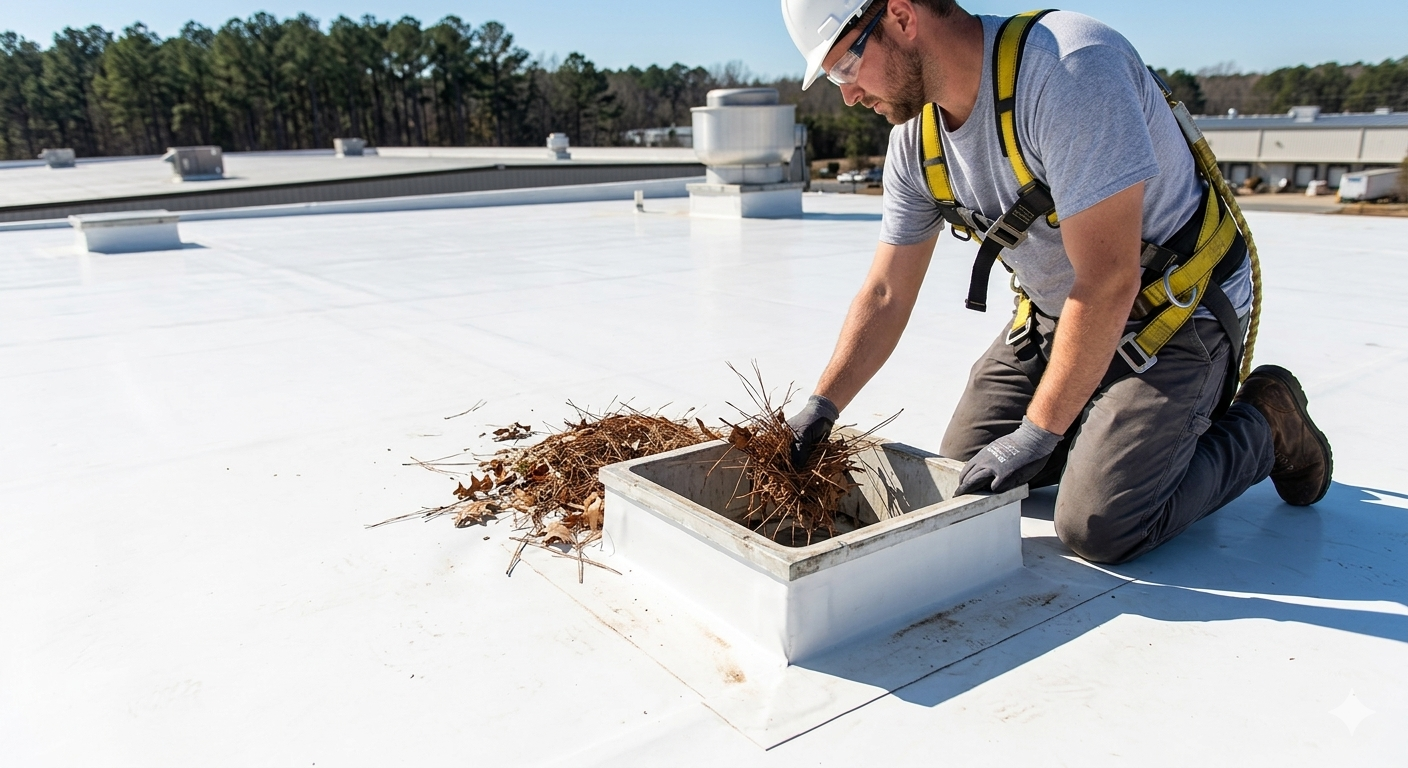
Raleigh’s lush, dense tree canopy is a defining characteristic of the City of Oaks, but it represents a continuous, severe operational hazard for commercial flat roofing systems. Heavy winds routinely carry massive quantities of pine needles, oak leaves, twigs, and organic silt onto flat commercial surfaces. Rainwater naturally washes this loose debris directly toward your internal roof drains, perimeter scuppers, and collector boxes.
When these critical drainage pathways become restricted or entirely choked by organic matter, rainwater has nowhere to go, resulting in immediate “ponding water” on the TPO surface. While high-quality TPO is engineered to be highly water-resistant, prolonged ponding water creates a massive localized weight load that puts dangerous physical stress on your building’s structural steel joists. Furthermore, standing water acts like a magnifying glass under the intense North Carolina sun, concentrating UV rays that break down the TPO polymer matrix and rapidly aging the membrane. Routine clearing of all drainage mechanisms—especially immediately following the heavy spring pollen drop and the autumn foliage shed—is a critical maintenance requirement.
3. Rigorous Inspection of High-Stress Seams and Roof Penetrations
Unlike traditional sloped residential roofs that rely on gravity to rapidly shed water, a commercial flat roof must behave like a completely seamless, monolithic waterproof swimming pool. TPO roof panels are joined together using specialized robotic hot-air welders that fuse the sheets into a single continuous membrane. However, the continuous cycle of extreme afternoon heating and rapid nighttime cooling—a localized atmospheric phenomenon known as thermal shock—forces the building to expand and contract constantly. Over time, this mechanical movement places immense structural stress on the welded seams.
Additionally, a typical commercial roof is punctured by dozens of necessary penetrations, including industrial HVAC curbs, plumbing vent pipes, electrical conduits, and structural guy wires. The localized flashing, pitch pockets, and commercial-grade sealants surrounding these penetrations degrade, dry out, and crack much faster than the field membrane due to direct, unmitigated UV exposure.
- Commit to a comprehensive professional commercial roof inspection at least twice a year, ideally in the spring and late autumn.
- Ensure a factory-certified technician meticulously probes all field seams and instantly refreshes aging sealants around penetrations before minor hairline fractures transform into inventory-destroying interior leaks.
Beware the Trap of Unqualified “Storm Chaser” Maintenance
When a localized hail storm or severe wind event impacts Wake County, transient, out-of-state roofing crews flood commercial parks offering fast, cheap repair and maintenance packages. Property managers must exercise extreme caution. These uncertified crews routinely perform incorrect, destructive maintenance.
For example, when attempting to repair a stressed TPO seam, a transient worker will frequently apply cheap, residential-grade silicone caulk or asphaltic mastic plastic roof cement directly over the TPO. Because TPO is chemically non-reactive with these standard products, the caulk will fail to adhere properly, creating a temporary aesthetic mask that traps moisture beneath it and aggressively rots the underlying polyisocyanurate insulation boards. True TPO maintenance requires professional mechanical cleaning, surface preparation, and specialized hot-air thermic welding tools that can only be properly executed by an authorized, permanent local contractor.
Secure Your Commercial Asset with G3 Roofing’s Maintenance Programs
Your commercial property’s roof is far too valuable to leave to chance or trust to fly-by-night operations with no local accountability. G3 Roofing provides comprehensive, custom-tailored, and highly technical TPO roof maintenance programs engineered explicitly to withstand the unique environmental pressures of the Raleigh climate. Our localized, manufacturer-certified commercial technicians possess the specialized diagnostic tools to identify and resolve micro-seam separations, flashing degradation, and drainage restrictions long before they manifest as devastating structural failures.
Protect your corporate bottom line, maximize your roof’s operational lifespan, and maintain peak energy efficiency. Contact the trusted local commercial authorities at G3 Roofing today to schedule a professional maintenance consultation for your facility.