For most homeowners in Wake County, your house is your most significant financial asset, and the roof is the single most critical line of defense protecting that asset. Whether your current roof has reached the end of its natural structural lifespan, or a severe North Carolina hailstorm has left it completely compromised, facing a full roof replacement can feel incredibly overwhelming. The very first question every homeowner asks is straightforward: How much is this going to cost me?
If you search the internet for a quick answer regarding “roof replacement cost Raleigh NC,” you will likely find wildly inaccurate, generic national averages that fail to account for local market realities. A true, accurate roof replacement estimate is not a one-size-fits-all calculation. It is a highly specialized formula determined by your home’s unique architecture, your choice of materials, and local municipal building codes.
To help you plan your capital investment with absolute confidence, let’s break down the exact transparent variables that dictate the bottom-line price of a high-quality residential roof replacement in the Triangle area.
1. Architectural Scope: Size, Pitch, and System Complexity
The foundational driver of any roofing estimate is the overall surface area of the roof, which the roofing industry measures in “squares.” One roofing square is equal to a 10-by-10-foot area (100 square feet). However, the gross square footage of your home’s interior floor plan does not directly equal your roof’s total square footage. Eaves, overhangs, garage roofs, and entryways all add substantial surface area.
Beyond pure size, the physical geometry of your roof plays a massive role in labor costs:
- The Pitch (Steepness): A standard, low-slope roof is safe for technicians to walk on freely, allowing for rapid installation. However, if your Raleigh home features a steep, high-pitched Victorian or modern design, the project requires specialized safety scaffolding, harnesses, and significantly more staging time. This naturally slows down production and increases labor costs.
- System Complexity: A simple gable roof with two flat slopes is far less labor-intensive than a complex hip roof broken up by multiple dormers, deep valleys, intersecting ridge lines, and brick chimneys. Every valley requires specialized ice-and-water shielding, and every penetration requires custom flashing, which demands meticulous, expert craftsmanship.
2. Material Selection: Striking the Balance Between Longevity and Budget
The specific roofing material you select will have the most dramatic impact on your upfront capital investment. In the Raleigh-Durham climate, you need a material that can easily withstand intense UV radiation, high atmospheric humidity, and sudden high-wind events.
Architectural Asphalt Shingles
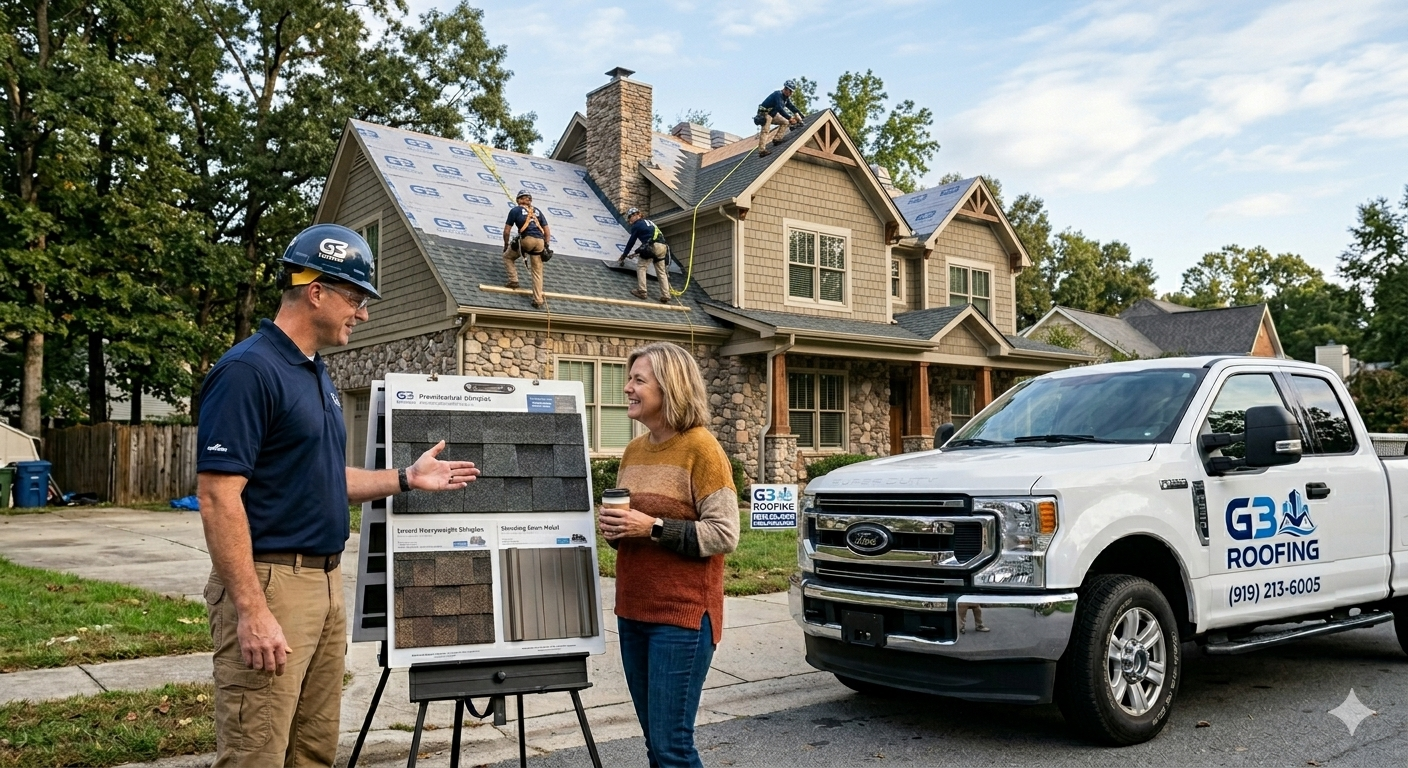
This is the most popular choice across the Triangle. Unlike flat three-tab shingles of the past, modern architectural (or dimensional) shingles are multi-layered, incredibly durable, and designed to mimic the depth of natural slate or wood shakes. They offer an outstanding balance of affordability and longevity, typically lasting 25 to 30 years when properly ventilated, and they carry strong wind resistance ratings up to 110–130 mph.
Luxury Heavyweight Shingles
For homeowners looking to maximize their curb appeal in premier Triangle neighborhoods, luxury asphalt shingles offer a massive, thick profile that provides unparalleled depth and multi-dimensional shadow lines. While they cost significantly more than standard architectural shingles, they offer superior impact resistance against hail and a substantially longer aesthetic lifespan.
Standing Seam Metal Roofing
An increasingly popular option in North Carolina, standing seam metal roofs represent a premium architectural tier. The upfront investment is roughly double or triple that of asphalt shingles, but the performance is unmatched. Metal roofs reflect immense solar heat away from your home during sweltering Raleigh summers—drastically lowering your energy bills—and can easily last 50+ years with virtually zero maintenance.
3. Structural Remediation: Saturated Decking and Tree Debris Damage
A significant portion of a roof replacement cost involves what lies beneath the shingles. When a roofing crew strips away your old roof, they expose the wood decking (usually plywood or OSB sheets).
Critical Note: A new roof can only perform as well as the deck it is nailed to. Building codes strictly prohibit nailing new shingles into soft, rotted, or structurally compromised wood.
Because Raleigh is proudly known as the “City of Oaks,” our dense tree canopy creates a unique local issue. Saturated leaves and pine needles frequently pile up in roof valleys, trapping moisture against the shingles for months at a time. If this moisture has bypassed your underlayment, it will quietly rot the underlying wood decking. If your inspection reveals rotted wood, those specific sheets must be completely cut out and replaced, adding to the material and labor cost of the project.
4. Local Wake County Variables: Permits, Disposal, and Code Compliance
Operating a legitimate, fully insured roofing company in the Triangle requires absolute adherence to local regulations. Your final project cost will always reflect these mandatory localized compliance elements:
- Municipal Permitting: Whether you reside in Raleigh, Cary, Apex, or Wake Forest, a residential roof replacement requires an official building permit and subsequent municipal inspections to verify structural compliance.
- Environmental Disposal Fees: Tearing off an old roof generates tons of heavy structural waste. A professional contractor utilizes designated local waste management facilities and pays mandatory environmental disposal and landfill fees to safely recycle or dispose of your old shingles.
- Up-to-Date Code Upgrades: If your home’s current roof is 20 years old, it was likely built under outdated building codes. Modern North Carolina building codes mandate specific structural upgrades during a full replacement, such as installing code-compliant drip edges along all eaves and rakes, and implementing specific ice-and-water barriers in all valleys.
The Ultimate Cost Trap: The Danger of Lowball “Storm Chaser” Bids
When budgeting for a roof replacement, you will occasionally receive a bid that is thousands of dollars lower than every other professional estimate. Property owners must exercise extreme caution here. These lowball prices are almost exclusively offered by transient, out-of-state “storm chasing” outfits.
To achieve those impossibly low prices, they cut catastrophic corners. They hire uncertified, uninsured day labor, bypass local permitting completely, use cheap, second-tier materials, and completely skip replacing critical flashing components. Even worse, because they operate out of temporary trailers and dissolve their local LLCs within months, your multi-decade workmanship warranty vanishes the moment their trucks drive away.
Invest in Permanence and Transparency with G3 Roofing
At G3 Roofing, we believe in absolute, mathematical transparency. We don’t believe in hidden fees, high-pressure sales scripts, or gimmicks. When we provide a comprehensive roof replacement estimate for your Triangle home, we break down every square foot of material, every piece of flashing, and every permit fee so you know exactly where your hard-earned money is going.
Your home deserves an elite structural system installed by an authorized, permanent local contractor who will be here to honor your warranty for decades to come. Protect your investment, secure your family’s safety, and achieve absolute peace of mind. Contact the local residential authorities at G3 Roofing today at (919) 213-6005 to schedule your transparent, data-driven replacement consultation.