For industrial asset managers, corporate facility executives, and commercial property owners across Wake County, managing a major structural asset like a commercial roof is an exercise in long-term risk management. A commercial roofing system is a highly complex, precisely engineered shield protecting millions of dollars of specialized machinery, proprietary technology, valuable inventory, and daily corporate operations. However, no structural system lasts forever.
When a commercial low-slope roof reaches the absolute end of its engineered operational lifespan, continuing to pour capital into endless localized patch repairs becomes a losing financial strategy. When minor hairline cracks evolve into systemic failures, a full commercial roof replacement is the only viable path forward to protect your facility.
Because a project of this magnitude represents a massive capital expenditure, executing a successful “commercial roof replacement Raleigh NC” requires a sophisticated understanding of modern single-ply technology, structural logistics, and localized environmental pressures.
Determining Your Asset’s Terminal Point: Repair vs. Replacement
The decision to completely replace a commercial flat roofing system should never be based on guesswork. It requires a detailed, forensic engineering assessment. The most critical metric determining the terminal failure of a commercial roof is the presence of widespread, subsurface moisture accumulation.
When a single-ply membrane (such as TPO, PVC, or EPDM) suffers unmitigated seam degradation or puncture damage, rainwater penetrates the top layer and becomes permanently trapped within the underlying polyisocyanurate (ISO) insulation boards. Because a flat roof lacks a steep pitch, this moisture has no way to drain or evaporate. In North Carolina’s intensely hot, high-humidity climate, this trapped water acts as a highly destructive force. It destroys the insulation’s thermal R-value, rapidly rusts out structural steel corrugated decking, breeds toxic mold, and places immense, un-engineered weight stress on the building’s support columns.
If a professional core-sample diagnostic test or thermal infrared scan reveals that more than 25% of your building’s underlying insulation is completely saturated, localized repairs are no longer a viable option. At that stage, a full system replacement is mandatory to prevent a catastrophic structural failure or roof collapse.
The Critical Choice: Total Tear-Off vs. Retrofit Layover
When engineering your commercial roof replacement, one of the most critical structural decisions you will make is choosing between a total tear-off and a retrofit overlay system.
Total Tear-Off
In a total tear-off, our commercial crews completely strip away the failing membrane, all saturated insulation boards, and all degraded flashing components down to the raw structural decking. We then inspect, treat, and repair any compromised structural steel or wood before building an entirely new, code-compliant roofing assembly from scratch. While this option commands a higher upfront labor cost, it completely eliminates hidden moisture, ensures the structural integrity of the deck, and qualifies your asset for elite, comprehensive manufacturer warranties.
Retrofit Overlay
A retrofit involves leaving the existing roof in place, mechanically clearing minor imperfections, laying down a thin separation slip-sheet or cover-board, and installing a brand-new single-ply membrane directly over the old system. While this provides an attractive upfront cost savings by eliminating extensive demolition labor and disposal fees, building codes strictly dictate that a commercial structure cannot support more than two independent roofing layers due to weight limitations. Furthermore, if you lay a new roof over hidden, wet insulation, that trapped moisture will continue to rot your building’s structural deck from underneath.
Selecting the Right Single-Ply Material for the Triangle Climate
Modern commercial roofing relies heavily on advanced single-ply thermoplastic membranes. Choosing the right polymer chemistry is essential to maximize the return on your investment based on your facility’s operational type:
- TPO (Thermoplastic Polyolefin): This is the gold standard for standard retail complexes, distribution hubs, and office parks across Raleigh. TPO’s brilliant white, highly reflective surface actively combats the urban heat island effect. It reflects intense solar radiation away from your facility, drastically lowering internal ambient temperatures and slashing your monthly commercial HVAC cooling costs during intense North Carolina summers.
- PVC (Polyvinyl Chloride): For industrial manufacturing plants, commercial kitchens, or facilities with intensive rooftop chemical exhaust systems, PVC is the premier choice. PVC membranes are highly specialized, engineered to resist long-term exposure to animal fats, harsh chemical oils, fuel residue, and industrial pollutants that would rapidly dissolve a standard TPO or EPDM roof.
The Power of an Elite No-Dollar-Limit (NDL) Manufacturer Warranty
A commercial roof replacement is a multi-decade capital investment, and your financial protection shouldn’t rest solely on a standard contractor’s workmanship warranty. To achieve absolute institutional security, your project must be engineered to qualify for a No-Dollar-Limit (NDL) manufacturer warranty.
An NDL warranty is an elite, manufacturer-backed guarantee issued directly by major chemical and material corporations (such as Carlisle, GAF, or Elevate). Under an NDL warranty, if a seam splits or a material failure occurs 15 years down the road, the manufacturing corporation covers the absolute, complete cost of all labor and materials required to make the roof watertight again—with zero financial cap.
To secure this elite level of protection, the roof must be installed by an explicitly certified Master Term Elite commercial contractor. The system must be engineered to match strict wind-uplift requirements, and a dedicated, third-party technical inspector from the manufacturer must physically step onto the roof upon completion to rigorously audit and sign off on every single square inch of craftsmanship.
Minimize Business Disruption with G3 Roofing
A commercial roof replacement is a highly technical, high-liability logistical dance. You cannot afford to hire a non-local, uncertified crew that will disrupt your tenants, block your loading docks, create safety hazards for your clients, or leave your facility exposed to sudden storm damage during the construction process.
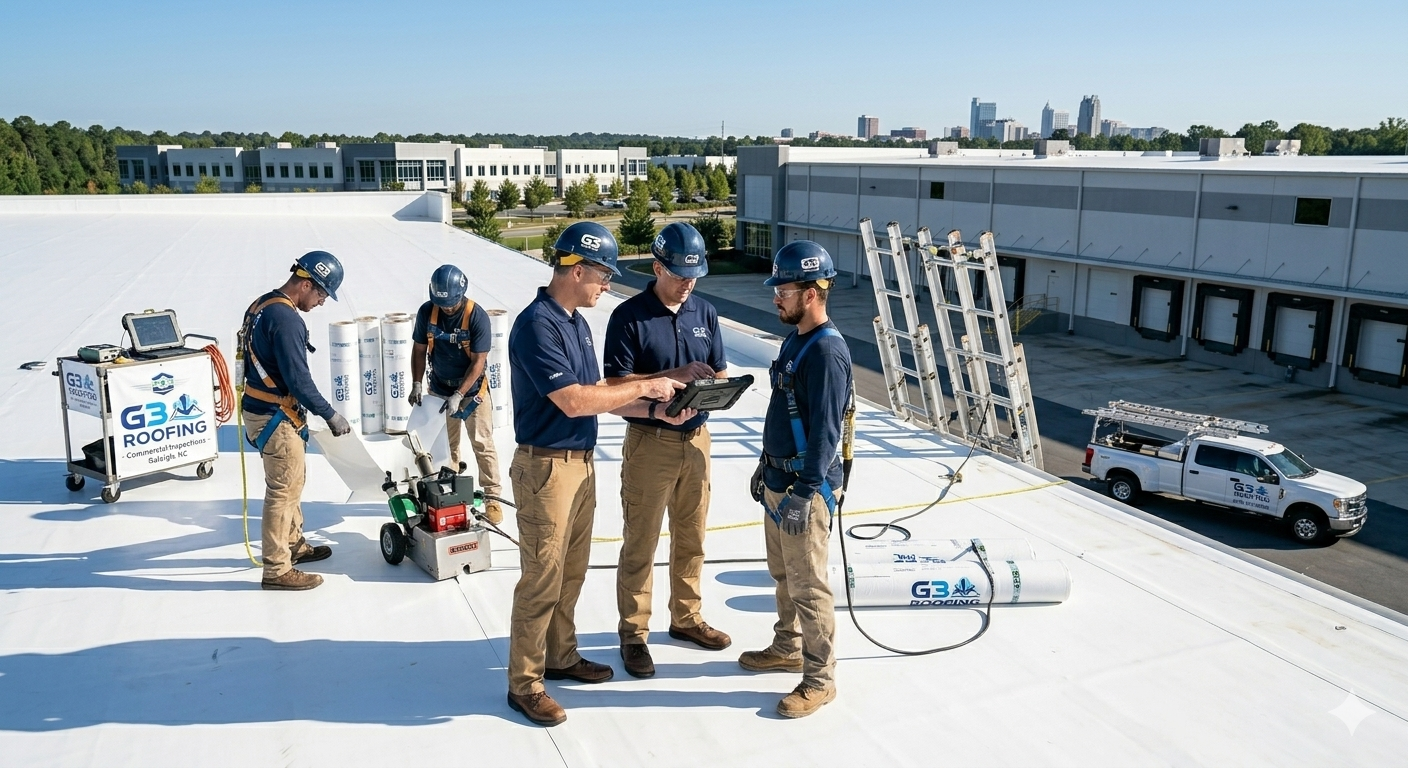
G3 Roofing is the premier authority on commercial low-slope infrastructure in the Triangle area. Our specialized commercial division understands the complex logistics of working around active commercial operations. We utilize advanced safety scaffolding, precise crane positioning, and meticulous staging protocols to ensure your daily corporate operations continue completely uninterrupted while we install your high-performance, watertight roofing system.
Do not leave your business’s most critical asset to chance or trust it to out-of-state entities with no local accountability. Contact the trusted commercial professionals at G3 Roofing today at (919) 213-6005 to schedule a professional, data-driven commercial replacement evaluation for your facility.